New York ARTCC
Standard Operating Procedure — Liberty TRACON
Rev. 5 — Revised: 2026-03-27
Area at a glance
- Purpose
- This document prescribes the procedures to be utilized for providing air traffic control services at Liberty Departure. The procedures described herein are supplemental to the New York ARTCC Standard Operating Procedures and FAA Order JO 7110.65.
- Distribution
- This order is distributed to all New York ARTCC personnel.
- Procedural Deviations
- Exceptional or unusual requirements may dictate procedural deviations or supplementary procedures to this order. A situation may arise that is not adequately covered herein; in such an event use good judgment to adequately resolve the problem.
Operational Positions
| Sector |
Callsign |
Frequency |
Identifier |
Combined Sector
|
| LaGuardia Departure |
LGA_DEP |
120.400 |
1L |
Primary Departure
|
| HAARP |
LGA_V_APP |
120.800 |
1V |
Primary Approach (LGA_APP when combined)
|
| Final Vector |
LGA_F_APP |
134.900 |
1F |
1V
|
| NYACK |
LGA_Y_DEP |
120.550 |
1Y |
1X (1L if NOBBI is not covered)
|
| EMPYR |
LGA_D_APP |
127.300 |
1D |
1V
|
| NOBBI |
LGA_X_APP |
126.400 |
1X |
1V
|
| Sector |
Callsign |
Frequency |
Identifier |
Combined Sector
|
| Final Vector |
JFK_A_APP |
132.400 |
2A |
2K
|
| CAMRN |
JFK_G_APP |
128.125 |
2G |
2K
|
| Kennedy Departure |
JFK_DEP |
135.900 |
2J |
Primary Departure
|
| ROBER |
JFK_K_APP |
125.700 |
2K |
Primary Approach (JFK_APP when combined)
|
| Kennedy Satellite |
JFK_M_APP |
118.400 |
2M |
2K
|
| Sector |
Callsign |
Frequency |
Identifier |
Combined Sector
|
| Calverton |
ISP_N_APP |
120.050 |
3N |
Primary TRACON (ISP_APP if combined)
|
| Islip |
ISP_H_APP |
134.550 |
3H |
3N
|
| SEALL |
ISP_R_APP |
133.100 |
3R |
3N
|
| VIKKY |
ISP_O_APP |
128.625 |
3O |
3N
|
| LOVES |
ISP_Z_APP |
124.075 |
3Z |
3N
|
| BEADS Low |
ISP_I_APP |
118.950 |
3I |
3N
|
| BEADS High |
ISP_B_APP |
125.975 |
3B |
3N
|
| Sector |
Callsign |
Frequency |
Identifier |
Combined Sector
|
| Newark Departure |
EWR_DEP |
119.200 |
4N |
Primary Departure
|
| Yardley |
EWR_P_APP |
128.550 |
4P |
Primary Approach (EWR_APP when combined)
|
| Final Vector 22 |
EWR_M_APP |
125.500 |
4M |
4P
|
| Final Vector 4 |
EWR_Q_APP |
125.500 |
4Q |
4P
|
| North Arrival |
EWR_A_APP |
120.150 |
4A |
4P
|
| MUGZY |
EWR_U_APP |
127.600 |
4U |
4P
|
| ZEEBO |
EWR_S_APP |
123.775 |
4S |
4U
|
| METRO |
EWR_H_APP |
132.800 |
4H |
4U
|
| Sector |
Callsign |
Frequency |
Identifier |
Combined Sector
|
| East |
NY_LE_DEP |
126.800 |
5E |
5W
|
| West |
NY_LW_DEP |
120.850 |
5W |
Primary TRACON (NY_L_APP when combined and covering Catskill)
|
| North |
NY_LN_DEP |
118.175 |
5T |
5W
|
| South |
NY_LS_DEP |
124.750 |
5S |
5W
|
| Catskill |
SWF_APP |
132.750 |
5H |
5W
|
TRACON
Coordination
- Procedures contained in Letters of Agreement shall apply at all times unless prior verbal (or textual) coordination between facilities has been affected otherwise.
- Point Outs
- When using an automated point out, verbal (or textual) approval must be obtained before an aircraft may enter another controller's airspace. An automated point out not accompanied by a verbal or textual description does NOT constitute a valid point out.
- Separation Minima
- Minimum radar separation between aircraft shall be at least three miles (intra-TRACON) or five miles (TRACON-Center) constant or increasing when transfer of control is accomplished. Other factors such as wake turbulence separation and miles-in-trail requirements may increase this minimum.
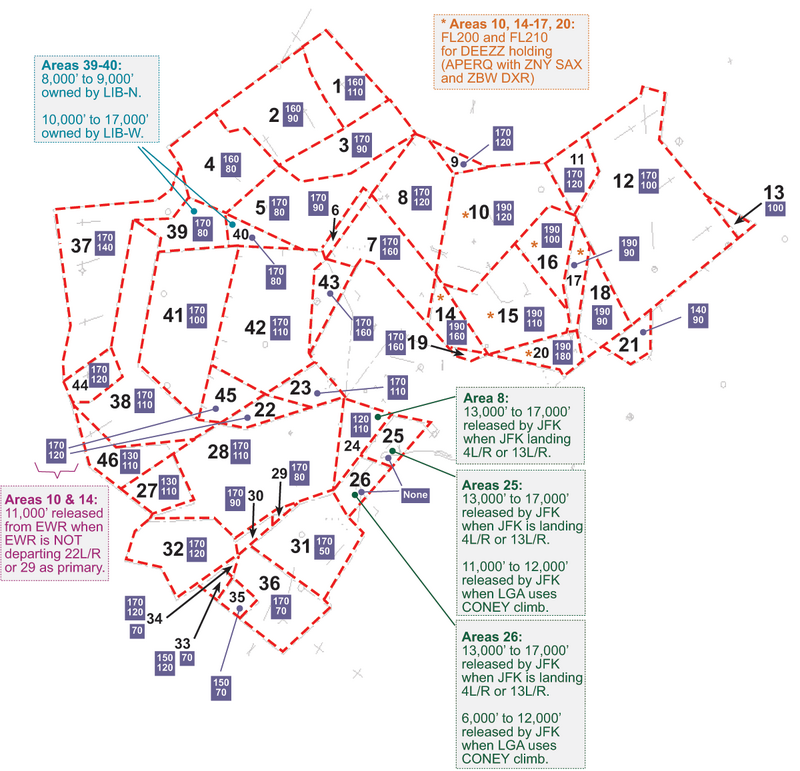
- NORTH - WEST
- NORTH is authorized to climb aircraft in WEST airspace reference WEST traffic provided that:
- NORTH aircraft are on headings to transition the EWR North Gate.
- NORTH controller uses “Quick Look” function to assess WEST traffic, including observing if the traffic is a Heavy or B757 when operating directly behind and less than 1.000 feet vertically from it.
- WEST notifies NORTH of any untagged targets
- WEST and NORTH must be on the same radar sensor to apply vertical separation.
- NORTH maintains responsibility for separation.
- WEST - SOUTH
- WEST is authorized to climb EWR Runway 22 departures in SOUTH airspace reference SOUTH traffic, provided that:
- WEST controller uses “Quick Look” function to assess SOUTH traffic, including observing if the traffic is a Heavy or B757 when operating directly behind and less than 1.000 feet vertically from it.
- SOUTH notifies WEST of any untagged targets.
- SOUTH and WEST must be on the same radar sensor to apply vertical separation.
- WEST maintains responsibility for separation.
- EAST - NORTH
- EAST is authorized to:
- Enter NORTH airspace at 17,000' after NORTH has accepted a handoff from EAST.
- Transfer communication directly to the New York Center (ZNY) after ZNY has accepted the handoff unless Chicago O’Hare (ORD) and /or Detroit Metro (DTW) in-trail restrictions, via the NORTH fixes, are in effect. Then, the East Controller will hand-off and frequency change all JFK and ISP Area North Departures to the North controller prior to 1 1/2 miles from the boundary.
- EAST shall coordinate with NORTH for aircraft which will enter NORTH’s airspace below 17,000'.
- NORTH and EAST are responsible to ensure a handoff has been com pleted on 17,000’ traffic (communicating with EAST) prior to the aircraft entering ZNY air-space.
- NORTH shall retain traffic at 16,000’ converging with 17,000’ traffic (communicating with EAST) until ZNY accepts handoff/point-out on the 17,000’ traffic.
- When holding is necessary, EAST will transfer communication of these departures to NORTH.
- The LIB FLMIC/CIC may suspend procedures when the volume of EAST traffic warrants it.
- EAST is authorized to climb LGAN traffic in NORTH airspace reference NORTH traffic, provided that:
- EAST controller uses “Quick Look” function to assess NORTH traffic, including observing if the traffic is a Heavy or B757 when operating directly behind and less than 1,000 feet vertically from it.
- NORTH notifies EAST of any untagged targets.
- NORTH and EAST must be on the same radar sensor to apply vertical separation.
- EAST maintains responsibility for separation.
Newark TRACON & Liberty TRACON Letter of Agreement
- Purpose
- This agreement prescribes transfer of control procedures, radar handoff procedures, route/altitude assignments, and delegation of airspace between Newark TRACON (EWR) and Liberty TRACON (LIB).
- Scope
- The procedures contained herein apply unless prior coordination is effected.
- Disclosure
- vZNY and any other facilities mentioned in this document are affiliated with the Virtual Air Traffic Simulation (VATSIM) network. The procedures outlined in this document are intended exclusively for use in the VATSIM flight simulation environment and must never be used for actual flight or air traffic control operations. vZNY and any other facility mentioned in this document are not affiliated with the FAA in any manner.
- General Procedures
- EWR Departure has the option to leave North props requesting 10,000' and above at 9,000' without coordination. Aircraft flight planned below 10,000' will be at 9,000'. LIB-N does not have control for climb on traffic at 9,000'.
- For departures to the South Gate exits, EWR Departure clears aircraft direct ELVAE at 6,000'/5,000' and releases control for climb to LIB-S. LIB-S is still responsible for coordination as required with the LGA area and/or LIB-W.
- LIB-N and LIB-W have control for turns of EWR and EWR satellite departures not to exceed headings necessary to transition through the respective departure gates.
- LIB-W has control for turns on SBJ gate traffic no farther north than the extended centerline of EWR Runway 11.
- LIB-N may hand off V249 traffic at 8,000' and 9,000' to METRO if there is a significant speed difference, with a point-out to EWR Departure.
- When EWR Satellite Departure is open, EWR/EWR SAT jets may transition the NORTH gate at 9,000' or 10,000' and should be at 10,000' when traffic permits.
- When EWR Satellite Departure is open, LIB-N may turn no further east than 5.5 NM from the western edge of the North Gate.
- EWR/EWR SAT will provide 20 miles-in-trail separation for departures via ELIOT.
LaGuardia TRACON & Liberty TRACON Letter of Agreement
- Purpose
- This agreement prescribes transfer of control procedures, radar handoff procedures, route/altitude assignments, and delegation of airspace between LaGuardia TRACON (LGA) and Liberty TRACON (LIB).
- Scope
- The procedures contained herein apply unless prior coordination is effected.
- Disclosure
- vZNY and any other facilities mentioned in this document are affiliated with the Virtual Air Traffic Simulation (VATSIM) network. The procedures outlined in this document are intended exclusively for use in the VATSIM flight simulation environment and must never be used for actual flight or air traffic control operations. vZNY and any other facility mentioned in this document are not affiliated with the FAA in any manner.
- Procedures
- LIBN has control for turns not to exceed headings needed to transition the departure gates. LGA departures may be turned beyond 320 track at or above 12,000'.
- LGA shall provide in-trail spacing of LGA and LGAN traffic towards SAX at 8,000' to LIBN. When a significant speed difference exists, V249 traffic may be handed off at 8,000' and 9,000' to LIBN.
- LGA shall hand off to LIBE climbing out of 9,000' for 10,000', 1.5 NM from LGA/LIB boundary. LIBE has control for turns at or above 9,000' not to exceed headings needed to transition the LGA East Gate.
- LIBE has control for climb to 12,000' for aircraft climbing to 10,000' from LGA, southwest of the LGA/LENDY boundary line, and to 15,000' northeast of the LGA/LENDY boundary line. LGA has the option to leave props requesting 10,000' and above at 9,000' without coordination. LIBE has control for climb for these aircraft in LGA Area #38 (LIB Area #29).
- LGAN shall hand off to LIBE climbing out of 10,000' for 11,000', 1.5 NM from the LGA/LIB boundary. LIBE has control for turns at or above 10,000' not to exceed headings needed to transition the LGAN East Departure Gate. Aircraft filed for 10,000' may be left at that altitude. LGAN has the option to hand off props requesting above 10,000' to LIB EAST at 10,000' without coordination. LIB EAST has control for climb in LIB Area #30 (LGA Area #41).
- LIBS has control for turns for LGA traffic to enter LIBS airspace south of the DPK R-282.
- LIBS has control for climb to 12,000' on contact on Coney Climb departures in Liberty Airspace #42 (LGA Airspace #17).
- LIBW has control for turns not to exceed headings needed to transition the departure gates.
- LGA prop departures to the west shall be climbing out of 11,000' for 12,000', 1.5 NM from the LGA/EWR boundary, and LIB has control for climb to 15,000'.
- When LIBW uses the JFK radar sensor, LGA shall treat PARKE and ELIOT departures as one, with 20 miles in-trail spacing.
- LGA shall hand off to LIBN:
- HAAYS prop and jet traffic requesting 12,000' to 17,000' - climbing to 12,000'.
- COATE jet traffic requesting flight levels - climbing to 15,000'.
- COATE prop traffic requesting flight levels - climbing to 12,000'.
- COATE props and jet traffic requesting 17,000' and below — climbing to 12,000'.
- Note: LGA has the option to climb HAAYS and COATE prop traffic to 11,000' for handoff to LIBN when jet traffic at 12,000' is a factor, without coordination. LIBN has control for climb to 12,000' on prop traffic handed off at 11,000'.
- LGAN has control for turns not to exceed headings needed to transition the departure gate for LIBH departures.
- LIBH has control for turns not to exceed headings needed to transition the Liberty Departure Gate for LIBH arrivals from the LGA Area.
- NYACK shall vector HPN departures landing LGA towards CMK at 5,000' and hand off to HAARP. HAARP has control on contact for turns to the south.
- LIB shall ensure aircraft remain on or north of the IGN R-107 (V58) to provide a minimum of 3.5 NM separation from the edge of the ANDLF holding pattern.
- When LIB is using SWF ILS Runway 27 approach, LGA will block 3,000' and below in Airspace Areas 43 and 44, remaining 1.5 NM from the boundary line.
- LIB may clear aircraft routed IGN V157 VALRE direct to VALRE.
John F Kennedy TRACON & Liberty TRACON Letter of Agreement
- Purpose
- This agreement prescribes transfer of control procedures, radar handoff procedures, route/altitude assignments, and delegation of airspace between John F Kennedy TRACON (JFK) and Liberty TRACON (LIB).
- Scope
- The procedures contained herein apply unless prior coordination is effected.
- Disclosure
- vZNY and any other facilities mentioned in this document are affiliated with the Virtual Air Traffic Simulation (VATSIM) network. The procedures outlined in this document are intended exclusively for use in the VATSIM flight simulation environment and must never be used for actual flight or air traffic control operations. vZNY and any other facility mentioned in this document are not affiliated with the FAA in any manner.
- Departures from/through JFK Area planned over GAYEL/HAAYS/NEION/COATE
- Departures from/through the JFK Area flight planned over GAYEL/HAAYS/NEION/COATE at or above 12,000’ shall be at or above 11,000’, 1.5 NM prior to the JFK/LIB boundary.
- Props shall maintain 12,000’, and LIB Area has control for climb to requested altitude on contact.
- Jets filed for flight levels shall climb to 17,000’.
- Jets filed for 14,000’-17,000’ shall climb to 16,000’, and jets filed for 12,000’ should be left at 12,000’.
- Departures from/through JFK Area planned over GREKI/MERIT/BAYYS/BDR
- Departures from/through JFK Area flight planned over GREKI/MERIT/BAYYS/BDR at or above 10,000’ shall be at or above 9,000’ climbing to 11,000’ (10,000’ for BDL, CEF, or BAF arrivals), 1.5 NM prior to the JFK/LIB boundary.
- JFK has the option to leave props at 9,000’ without coordination.
- EAST has control on contact for climbs to 17,000’ (13,000’ on the east side of the ZBW/ZNY boundary) and for turns not to exceed headings needed to transition the combined NORTH and EAST Departure Gate, referencing known traffic in JFK DEPARTURE airspace still on JFK DEPARTURE frequency.
- Departures from/through the JFK Area planned over RBV/ARD/WHITE
- RWY 4 RBV departures shall be issued direct RBV, and ARD departures shall be vectored towards RBV. When LGA is on Coney Climbs, both RBV and ARD departures will be issued 9,000’. SOUTH has control for climb and turns to the west.
- RWY 13 RBV departures shall be issued direct RBV, and ARD departures shall be vectored towards RBV, both climbing to 11,000’. SOUTH has control for climbs and turns to the west.
- RWY 22 departures shall remain on the assigned heading or route with coordination. SOUTH has control for climb from 7,000’ to 11,000’, 1.5 NM SW of the JFK 15 NM arc. SOUTH has control for turns to the west.
- RWY 31 RBV and WHITE departures shall remain on the SID. With coordination, JFK will climb to 11,000’, otherwise, SOUTH has control for climb from 7,000’ to 11,000’, 1.5 NM SW of the JFK 15 NM arc. SOUTH has control for turns to the west.
- When LIB owns the Narrows, SOUTH has control for climb on JFK DIXIE jets and WHITE departures.
- WHITE/WAVEY Route SWAP (WWRS)
- Hand off JFK WHITE jet departures to LIB at the coordinated RBV departure altitude.
- JFK WHITE prop departures and overflights remain routed via V1.
- DCA traffic may remain over WAVEY, no higher than 16,000’, or be filed/re-routed over WHITE.
- APREQ FRG BEADS
- LGA hands off all WAVEY and SHIPP jet departures direct JFK to pass between CRI and JFK ILS RWY 22L FAF, direct to the appropriate fix at 8,000’. JFK Area has control on contact for climb and turns from 140° to 210° not to exceed the gate.
       Coney Climb Airspace
       [Show]
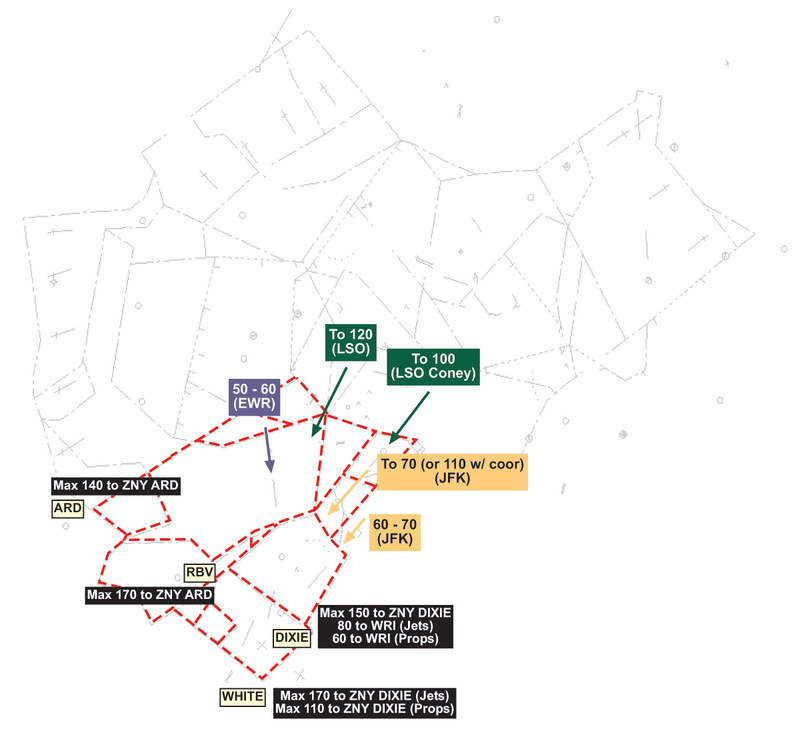
- When JFK delegates the airspace for Coney Climbs to LGA DEPT, the following areas shall also be released, after coordination, to LIB SOUTH:
- JFK Area #7 at 11,000’ and 12,000’.
- JFK Area #8 from 6,000’ to 12,000’.
- When JFK is landing RWY 4L/R or 13L/R, JFK shall release, with coordination, JFK Area #9 & 9A, from 13,000’ through 17,000’ to SOUTH.
- SOUTH has control for climb on JFK RBV, ARD, DIXIE jets, and WHITE departures, with control for turns to the west on RBV/ARD departures.
- When JFK is landing RWY 4L/R, and LIB has the Narrows AND LGA is making CONEY Climbs, JFK shall release, with coordination, Areas #7 and #8 to SOUTH, from 13,000’ to 17,000’.
East Departure
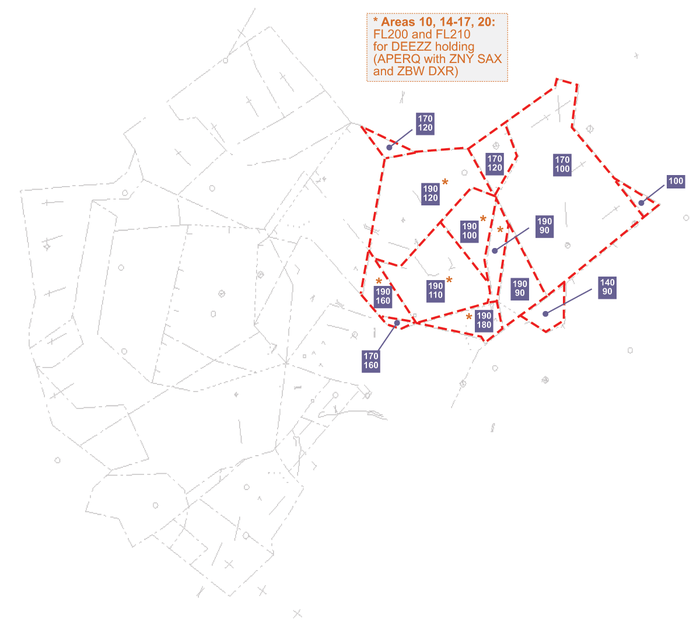
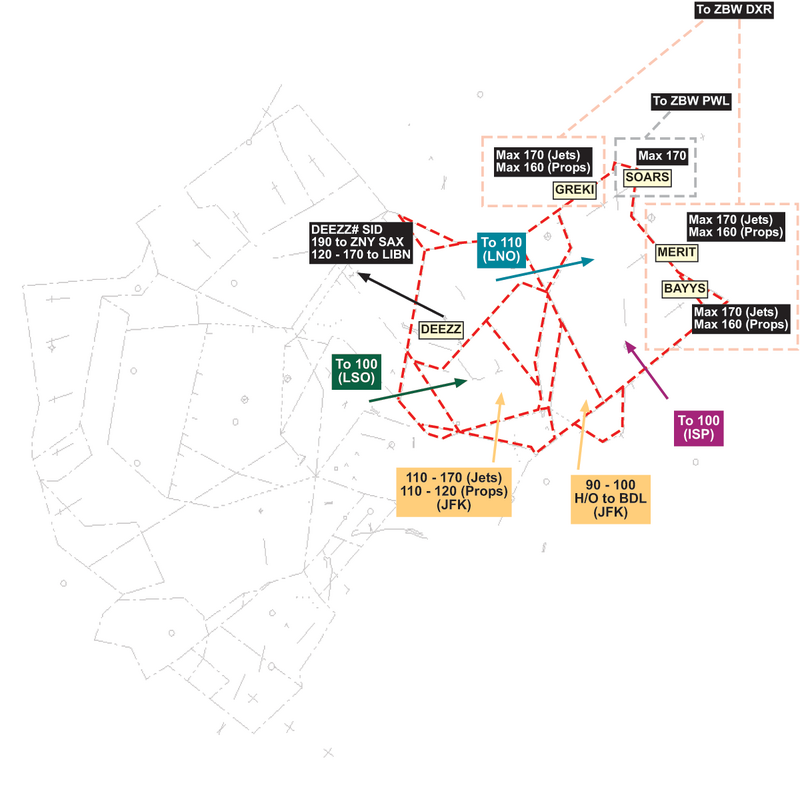
Departure Chart
Procedures
- LGA DEPARTURE shall hand off East Departures climbing out of 9,000' for 10,000'.
- EAST has control for turns at or above 9,000' not to exceed headings needed to transition the LGA East Gate. EAST has control for turns of LGA aircraft below 9,000' as to go through the LGA East Gate south of HAARP airspace.
- EAST has control for climb to 12,000' for aircraft climbing to 10,000' from LGA DEPARTURE southwest of the LGA/LENDY boundary line and to 15,000' northeast of the LGA/LENDY boundary line. LGA DEPARTURE has the option to leave props requesting 10,000' and above at 9,000' without coordination. EAST has control for climb on these aircraft in LIB Area 29.
- LGA NYACK shall handoff to EAST out of 10,000' climbing to 11,000' when filed above 10,000'. EAST has control for turns not to exceed headings needed to transition the HPN East Gate. LGA NYACK has the option to handoff props requesting above 10,000' to EAST at 10,000' w/o coordination. EAST has control for climb in LIB Areas #10 and #11 (LGA Area #40).
- Departures from/through the JFK Area flight planned over COATE/GAYEL/HAAYS/NEION/DEEZZ at or above 12,000' shall be at/above 11,000', 1 ½ nm prior to the JFK/LIB boundary. Props shall maintain 12,000' and LIB has control for climb to requested altitude on contact. Jets filed for FL shall climb to 17,000'. Jets filed 14,000'-17,000' shall climb to 16,000' and jets filed for 12,000' shall be left at 12,000'. EAST has control for turns not to exceed headings needed to transition the Departure Gate.
- Departures from JFK Area planned over BDR/BAYYS/GREKI/MERIT at or above 10,000' shall be at/above 9,000' climbing to 11,000' (10,000' for BDL, CEF or BAL arrivals) 1 ½ nm prior to JFK/LIB boundary. JFK has option to leave props at 9,000' without coordination. EAST has control on contact for climbs to 17,000' (13,000' on the east side of ZBW/ZNY boundary) and for turns not to exceed the headings needed to transition the combined NORTH and EAST Departure Gates.
- ISP Area departures shall be level at 10,000', 1 ½ nm from the ISP East Departure Gate. EAST has control for turns not to exceed headings needed to transition the ISP East Departure Gate.
North Departure
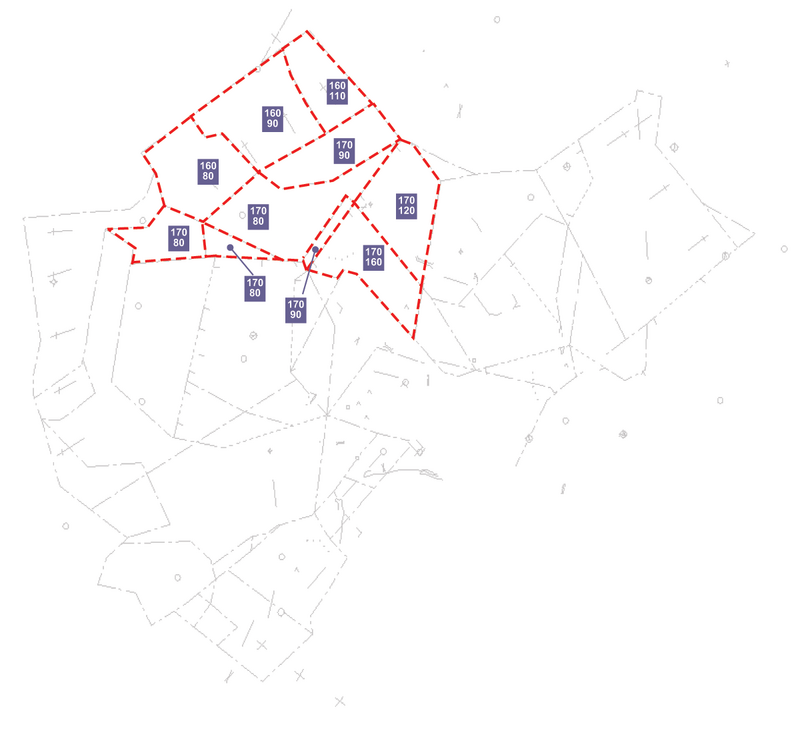
Departure Chart
Procedures
- NORTH has control for turns not to exceed hdgs needed to transition the Departure Gates.
- When EWR SATELLITE is open, NORTH may turn EWR departures no further east than 5-1/2 NM from the western edge of the NORTH Gate.
- LGA departures may be turned beyond 320° track at or above 12,000'.
- LGA shall hand-off to LIB NORTH:
- NORTH jet traffic requesting flight levels: climbing to 15,000'.
- COATE jet traffic requesting 12,000' to 17,000': climbing to 12,000'.
- COATE prop traffic requesting 12,000' and above: climbing to 12,000'.
- HAAYS prop and jet traffic requesting 12,000' to 17,000' - climbing to 12,000'.
- LGA has the option to climb HAAYS and COATE prop traffic to 11,000' for hand-off to LIB NORTH when jet traffic at 12,000' is a factor, without coordination. NORTH has control for climb to 12,000' on prop traffic handed-off at 11,000'.
- LIB NORTH is required to coordinate with LGA DEP when holding is necessary below 16,000'.
- LGA Area shall provide in-trail spacing of LGA and LGAN SAX traffic at 8,000'. When a significant speed differential exists, V249 traffic may be handed off at 9,000' from LGA to NORTH and from NORTH to METRO. NORTH shall point out 9,000' traffic via V249 to EWR DEPARTURE.
- EWR DEPARTURE has the option to leave NORTH props requesting 10,000' and above at 9,000' without coordination. Aircraft flight planned below 10,000' will be at 9,000'. NORTH does NOT have control for climb on traffic at 9,000'. When SATELLITE DEPARTURE is open, EWR/EWR SAT jets may transition the NORTH Gate at 9,000' or 10,000', but should be at 10,000' when traffic and workload permit.
- EWR Area shall provide 8 NM in-trail for similar type EWR and EWR SATELLITE North departures to the same fix.
- EWR Area shall ensure that all NORTH traffic is at or above 9,000' , 1 1/2 NM from the NORTH Departure Gate to protect SAX traffic at 80 traffic.
- Traffic destined PNE, TTN, NXX and LOM routed over SAX shall be left at 8,000' maximum.
- NORTH has control for turns of traffic handed off by EAST.
- Newark has control for turns on Solberg overflight traffic from Liberty at 8,000', west of the IGN R-219.
- NORTH has the ability to view customized quick look areas by using the entry “F12Q, Enter”. This one entry will enable the controller to view both “54” tags and “1L” tags in a specific area designed to display only pertinent traffic (see Par 2-5-10a).
- LGA Area shall provide in-trail spacing of LGA and LGAN SAX traffic at 8,000'. When a significant speed differential exists, V249 traffic may be handed off at 8,000' and 9,000' from LGA to NORTH and from NORTH to METRO. NORTH shall point out 9,000' traffic via V249 to EWR DEPARTURE in a timely manner.
- EWR DEPARTURE has the option to leave North props requesting 10,000' and above at 9,000' without coordination. Aircraft flight planned below 10,000' will be at 9,000'. NORTH does NOT have control for climb on traffic at 9,000'.
West Departure
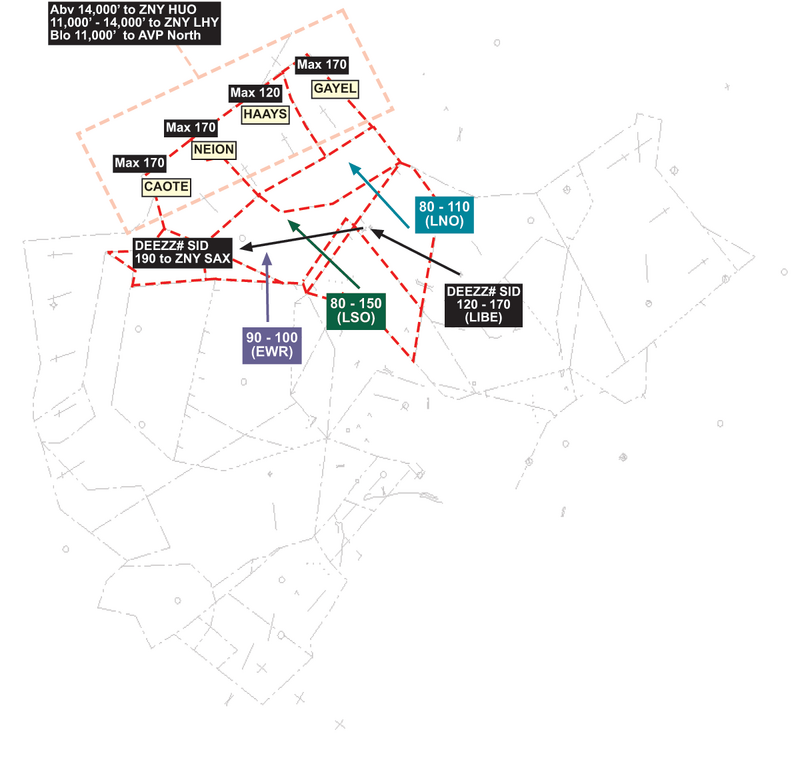
Departure Chart
Procedures
- LGA props through WEST shall be climbing out of 12,000'. WEST has control for climb to 15,000' northwest of LGA/LENDY boundary.
- WEST has control for turns for LGA Area departures north/west of the LGA/LENDY boundary not to exceed headings needed to transition the Departure Gate.
- WEST has control for turns of EWR and EWR SAT departures not to exceed headings needed to transition the respective departure gates.
- EWR SATELLITE will provide 20 MIT for similar type ELIOT departures.
- WEST has control for turns on SBJ Gate traffic no further north than the extended centerline of EWR RWY 11.
- When EWR SATELLITE DEPARTURE position is not staffed, EWR West and EWR SAT West Gates shall be considered one gate. EWR has the option to hand off aircraft of parallel courses to different fixes and parallel EWR and EWR SAT departures to ELIOT.
- EWR Auxiliary RWY 29 prop departures shall transition out of the EWR West Gate when departing RWY 4L/R, and out the EWR SAT Gate when departing RWY 22L/R, except BIGGY departures which will use the EWR West Gate.
- When EWR SATELLITE DEPARTURE position is not staffed, EWR WEST and EWR SAT WEST Gates shall be considered one gate.
- MMU departures may be in-trail with either EWR or EWR SATLLITE departures out of the appropriate gate at the discretion of the coordinator.
South Departure
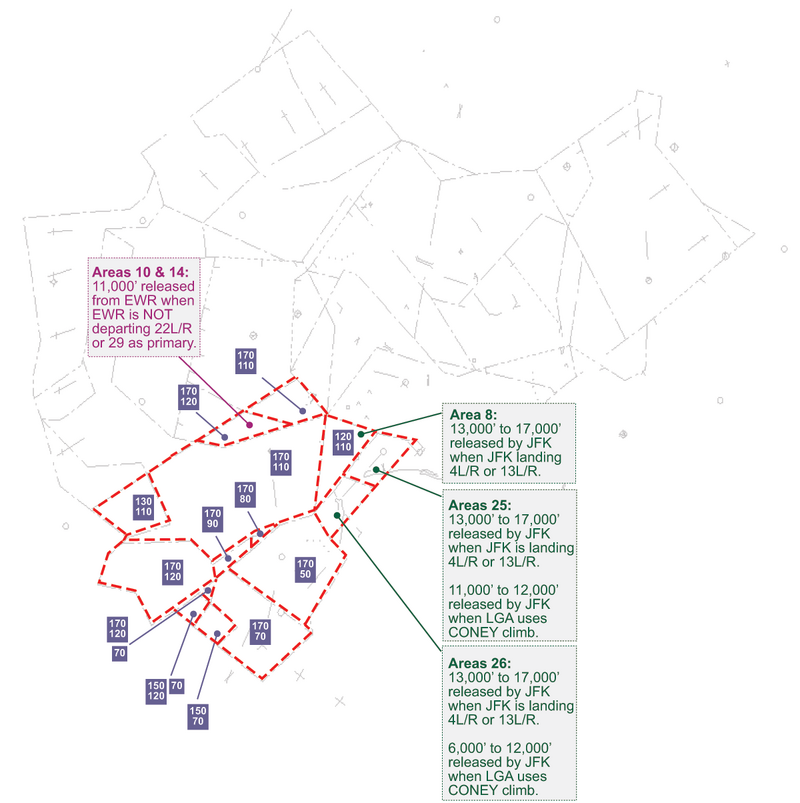
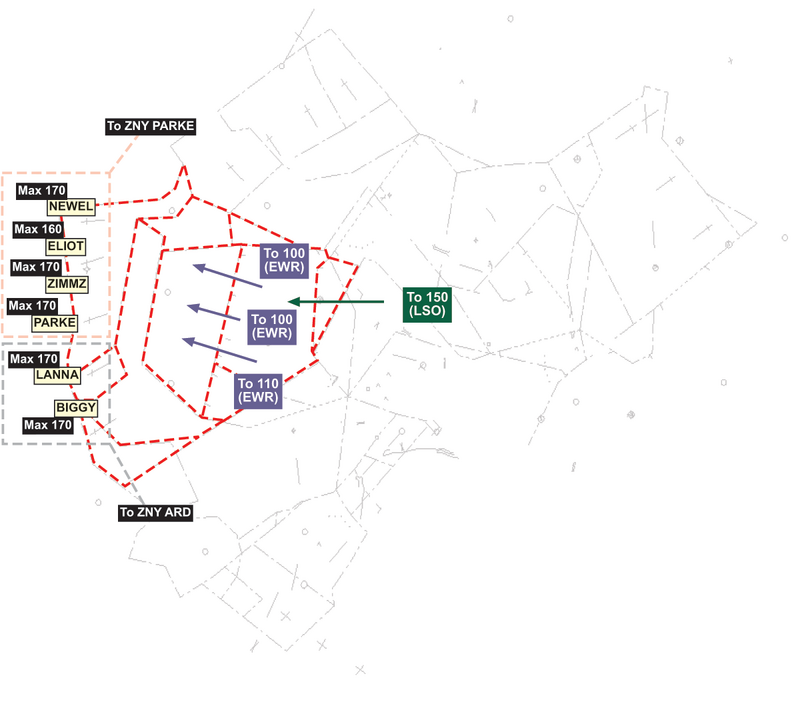
Departure Chart
Procedures
- JFK Conditional Airspace
- Coney Climb Airspace – When JFK delegates the airspace for Coney Climbs to LGA Departure, the following areas shall also be released after coordination to SOUTH
- LIB Area #25 (JFK Area #7) at 11,000' and 12,000'
- LIB Area #26 (JFK Area #8) from 6,000' to 12,000'
- Narrows Airspace – When JFK is landing 4L/R or 13L/R, JFK shall release, with coordination, LIB Area 8 from 13,000' through 17,000' to SOUTH
- SOUTH has control for climb on JFK RBV, ARD, DIXIE jets and WHITE departures and control for turns to the west on RBV and ARD departures
- Narrows Extension – When JFK is landing 4L/R and LIB has the Narrows AND LGA is on CONEY Climbs, JFK shall release, with coordination, LIB Areas #24 (JFK Areas #9 and #9A) to SOUTH from 13,000' to 17,000'.
- JFK jets over RBV/WHITE and Props over ARD:
- Rwy 4 – RBV departures shall be issued direct RBV and ARD departures shall be vectored towards RBV climbing to 11,000'. When LGA is on Coney Climbs, both RBV/ARD departures will be issued 9,000'. SOUTH has control for climbs and turns to the west.
- Rwy 13 – RBV departures shall be issued direct RBV and ARD departures shall be vectored towards RBV both climbing to 11,000'. SOUTH has control for climbs and turns to the west.
- Rwy 22 – Departures shall remain on the assigned heading or SID climbing to 7,000'. With coordination, JFK will climb to 11,000', otherwise, SOUTH has control for climb from 7,000' to 11,000' 1 ½ nm SW of the JFK 15 nm arc. SOUTH has control for turns to the west.
- Rwy 31 – Departures shall remain on the assigned heading or SID climbing to 7,000’. With coordination, JFK will climb to 11,000', otherwise, SOUTH has control for climb from 7,000' to 11,000', 1 ½ nm SW of the JFK 15 nm arc. SOUTH has control for turns to the west.
- EWR DEPARTURE, upon transferring departures via COL R-350 at 5,000'-6,000', releases control for climb to SOUTH. SOUTH is responsible for coordination as required with LGA and/or WEST.
- When EWR is on NE flow, SOUTH has control for turns 20 degrees to the right for southbound traffic departing EWR/TEB when traffic is abeam EWR provided traffic is climbing.
- SOUTH has control for turns for LGA traffic south of DPK R-282 so as to enter SOUTH's airspace south of DPK R-282.